Friday, April 12, 2013

5 Things to do at the Dentist's Office

 By Dr. Mark Burhenne, Special to CNN


Editor's note: Mark Burhenne is a practicing family and cosmetic dentist of 25 years and founder of AsktheDentist.com. He is dedicated to empowering people to take control of their dental health, stop managing symptoms and prevent chronic illnesses in the mouth. Follow him on Facebook or Twitter.

(CNN) -- The recent news in Tulsa, Oklahoma, brings to light an issue that is rare, but nonetheless important -- cross infection in the dental office, or the transfer of infection from one patient to another in a health care environment.

The unfortunate reality is that you, as the consumer, have very little chance of knowing what's going on -- it's a huge trust relationship. Cross contamination is literally invisible because it's caused by microbes invisible to the human eye, so only the professionals can guarantee that it doesn't happen.
That doesn't mean it's out of your control. Use this checklist to find out how seriously your dentist takes the issue of infection control procedures.

1. Watch the gloves
You would never use a cutting board used for raw chicken to chop up some broccoli unless you washed it first -- and preventing cross infection in the dental office is no different.
Ask yourself:
-- How does my dentist put on gloves? Gloves put on by your dentist should come out of the glove dispenser, not off an unsterilized countertop.
-- What does my dentist touch with the gloves? Your dentist should only touch the sterile instruments or your mouth -- if anything else gets touched or if the dentist leaves the room, it's time for a new pair of gloves.
-- How many soap containers do I see in the office? Soap containers should be visible and everywhere and dentist and staff should be making use of them in front of you, in addition to using gloves.
Ask your dentist:
-- Do you change your gloves for every patient? Gloves should absolutely be changed in between patients.

2. Check out the office
A clean, uncluttered office can be an indication of how serious your dentist is about sterilization. If the office is cluttered, it's harder to clean.
Ask yourself:
-- How clean is the office? Is it tidy and uncluttered? If there's lots of junk on the countertops, that can make for surfaces that aren't easily sterilized.
-- Are there carpets? Carpets can't be sterilized, but hospital-grade linoleum floors can. These can all be indications of how serious a dentist is about cleanliness.
-- Are there special containers for disposal of needles and sharp items? If you can't see them, ask where they're kept. Devices have to either be sterilized or thrown away. A dentist should be using these containers to dispose of used devices and using new ones on the next patient.

Ask your dentist:
-- Are operatory rooms (the room where the dental chair is) cleaned between patients? The staff should be disinfecting the surfaces in the operatory between every patient.
-- Where do you disinfect instruments? There should be a single room or space in the dental office that is completely dedicated to the disinfection of instruments. Ask your dentist to tell you about this space and what the procedures are.
-- How do you sterilize your instruments? Instruments should be sterilized in between each patient, including the dental drill.
-- How do you know that the sterilizer is working properly? This brings me to my next point.

3. Ask for autoclave validation
In my office, this is a form that we keep on our bulletin board. It's a certificate from a third party company that sends the dentist a package full of envelopes of bacteria that are difficult to kill.
The dentist or staff will put these bacteria into the sterilization machine -- or autoclave, in dental terms -- weekly or monthly, put the package into the mail, and the company analyzes the package and sends a report to the dentist on how well the sterilization machine is functioning. Another word for this is biological monitoring.
Ask your dentist:
-- May I see a copy of your autoclave validation? If your dentist is willing and able to show you this report, this demonstrates a commitment and dedication to protecting your health. If your dentist doesn't want to show you or gets defensive, this could be a red flag.

4. Check the instruments
Your dentist should be unwrapping a sealed bag of instruments in front of you. A sealed bag indicates that the instruments have been sterilized -- or in dental terms, autoclaved -- by a machine. If bag is already open, then it's possible that those are used instruments that contain another person's germs.
Ask yourself:
-- Where did the instrument come from? Once instruments are out of the sterilized bag, your dentist should leave them on a sterile tray, not a dirty countertop.
Ask your dentist:
-- Do you use the bags that change color when they're autoclaved? Many autoclave bags have a color indicator on them to indicate that the instruments inside were properly sterilized. Not all bags have this, but it can start a good conversation with your dentist about sterilization procedures used in the office.

5. Speak up
Never be afraid to ask questions. A good dentist will be proud to tell you of the measures the office takes to ensure your safety, protection and well-being.
Ask your dentist:
-- "In your office, how do you guarantee that you do not cross infect patients?" The dentist's reaction to this alone is telling. The dentist and staff should be dedicated to answering your questions and making you feel comfortable.

And do your research. The more you know about this topic, the better able you will be to engage in a conversation with your dentist. Do a background check. Usually, there's a governing body that oversees dentists in your state. They keep a record of infractions -- call to find out if your dentist is on that list. Educate yourself about dental infection control standards. The Occupational Safety and Health Administration, the Centers for Disease Control and the American Dental Association can help.

If you ever see something that makes you believe that your dentist and the staff are not perfectionists when it comes to cleanliness, trust your instincts and go somewhere else, or at least speak up.

Cross infection, in general, is exceedingly rare because dentists follow strict state and federal guidelines. The risk of your health being affected by not seeing the dentist is far greater than the risk of cross infection.


 Thank you to CNN for this very informative article. Find Original Source here: http://www.cnn.com/2013/03/29/health/dentist-5-things/index.html

Friday, March 22, 2013

How Quickly Do Germs Spread in the Office?


We've all done it. Come to work when we're sick.
We know we're not doing our fellow workers any favors by exposing them to whatever we've got, but pressure to get our jobs done almost always trumps common sense.

Well, now there is research to back up what common sense has been telling us all along: It's a bad idea.
Environmental microbiologist Kelly Reynolds at the University of Arizona in Tucson noticed the trend in her own office. As winter wore on, more and more of her colleagues started feeling ill. "So we asked the obvious question: how well do germs spread if one person comes to work sick?" she said.
So Reynolds and her team launched a study in one of the University of Arizona offices involving a typical cast of winter characters: several dozen coworkers in good health and one "sick" colleague carrying a virus mimicking the flu.
Within four hours, more than 50 percent of surfaces and employees were contaminated with the virus. Pretty startling stuff.
We spoke with Reynolds recently to learn more about her experiment.

NEWSHOUR: Kelly, thank you so much for joining us. Anyone who has worked in an office has had suspicions about how quickly germs spread in an office but your study puts a time stamp on it. Tell us how you came to these conclusions.
KELLY REYNOLDS: Well we targeted an office building of 80 people and we asked 10 of those people to volunteer to be "artificially inoculated" with a surrogate virus. These are viruses we know infect bacteria -- not infect humans -- but they have very similar survival and spread tendencies as influenza and other viruses that we know cause disease in humans. And so we put droplets of water on their hands, and one of those drops of water, unbeknownst to the participant, had this surrogate virus present in the droplet.
The level of virus in that droplet simulated what you'd expect on a person's hands if they were sick. We then asked them to go about their workday. And by noon -- four hours into the workday -- we went and swabbed commonly used surfaces in that office building and sampled the hands of all the coworkers. Half of those surfaces and half of the hands of the coworkers tested positive for the virus that we planted.
NEWSHOUR: That's pretty quick. Is it what you expected?
KELLY REYNOLDS: I was very surprised at how effectively our virus spread. Because in the office building we targeted, people tended to stay in their cubicals or in their offices the majority of the day. There was very little social interaction. It seemed like people were very isolated in their offices. But throughout the day, everybody tended to go to the bathroom at least once and they tended to touch one of the common areas.
NEWSHOUR: Which common areas?
KELLY REYNOLDS: We were targeting surfaces that we know are commonly touched but maybe rarely disinfected -- things like the computer keyboard, the computer mouse, the desktop in front of an individual's workspace. But then we also went into the common areas of the office building and tested the coffee pot, the refrigerator handle, a copy machine that an entire floor shared, doorknobs, faucets in the bathrooms.
NEWSHOUR: Were there different types of bugs that lasted longer on these surfaces?
KELLY REYNOLDS: We were only looking for the bug that we planted. In the real world, different pathogens survive at different rates. Probably the maximum survival rate is three days, and the minimum is a couple of hours. If it's a metal surface, they only survive for hours. If it's a plastic surface, they tend to survive much longer. If it's a porous surface, you know some plastics have little grooves in it -- if there's more organic matter, more dirt, then that's protective for the organism. The influenza and cold viruses can survive up to three days on surfaces.
NEWSHOUR: We always hear about things we can do to prevent the spread of germs in the workplace -- the No. 1 being stay home. But what about simpler steps, like washing your hands and using hand sanitizer, how effective did you find those to be?
KELLY REYNOLDS: We put together for this study what we called the 'healthy workplace interventions,' which had three parts:
The first was providing tissues to the employees, so if they had to blow their nose or cough, they used a tissue rather than their hands.
The second part was to provide hand sanitizer at each individual's desk that they could use throughout the day. We didn't really tell them how often to use it -- we just asked them to be aware when they think they come in contact with somebody or something that's contaminated, like the bathroom.
And then we asked them also to use disinfecting wipes. We provided a bottle of disinfecting wipes and asked them to use them at least twice a day. So maybe when they first got into work, and then maybe right before they ate lunch at their desk, or at the end of the day before they left.
We didn't monitor any of that, we just gave that advice and asked people to do that. And so after we gave people a couple of days to get used to the 'healthy workplace interventions,' we repeated the study by inoculating a single person's hands and watched how the virus spread. And we found that the risk of infection from exposure to contaminated surfaces and other people's hands was reduced by up to 90 percent.
NEWSHOUR: You also studied the behaviors that spread germs fastest. What did you find?
KELLY REYNOLDS: It tends to be a general perception that people are worried when somebody in their vicinity sneezes or coughs. And certainly this is a mechanism for germs to be transmitted in the environment. But it's much more likely that you'll come into contact with somebody else's germs from a contaminated surface, because the viruses in aerosols just don't stay in the air very long. They tend to settle on surfaces. And that's where they survive for hours to days. And so you're much more likely to pick up a germ from where that person has coughed even though you don't even realize you've come into contact. And that's why it's important to have these 'healthy workplace interventions' in place all the time.
The other thing to be aware of is how often you touch your face with hands that may not be clean. We tend to have a habit of wiping our noses, or rubbing our eyes, and the eyes, nose and mouth are entry routes into the body for germs. So be careful not to touch your eyes, nose or mouth when you know you haven't washed your hands recently.
NEWSHOUR: How much does environment play into this? Does the office set-up have a role?
KELLY REYNOLDS: I think so. As a population, we have moved further away from people living in rural environments and people are coming together in higher populations in city settings. And so there's obviously more industry, more opportunities to work in these large office buildings. And we just tend to come into more contact with more people more often.
So we've moved away from being farmers out in the field and shopping at our local markets for local produce and supplies to really having a global food supply. There's also lots of travel happening, so you could come into contact with anybody in the world in a very short period of time. So we have a much higher increase in interaction and a complete change toward more than an urban system, where we are in much closer proximity to one another.
NEWSHOUR: After your study, have people changed their behavior at your own workplace?
KELLY REYNOLDS: Yes they have. But I have gone around the workplace and said to people, "Those are the same disinfecting wipes that I gave you. I think it's time to use those up and get some new ones." That's another issue -- when we get a little too lazy about things, we forget. I think that's something employers can really do: remind your employees, send an email out once in awhile. Use these products that we know are effective, and stay home when you're sick.
One of the things about the flu is that you could be shedding the virus, you could be contagious before you've even experienced symptoms. And even when your symptoms stop, after five days of the flu, you can still be contagious and not even realize it. You may feel like you can go back to work, your symptoms have subsided, but you could still be contagious to your coworkers. In that way, it's not necessarily the responsibility of the person who's sick -- it's the responsibility of everybody else to make sure they're following these protocols, as well.
NEWSHOUR: It's a very interesting study. Kelly Reynolds, thank you so much for joining us.
KELLY REYNOLDS: Thank you.


 Thank you PBS for sharing the very informative transcript and article with us!


 Original Source:

http://www.pbs.org/newshour/rundown/2013/03/how-quickly-do-germs-spread-in-the-office.html

Thursday, February 28, 2013

Five Important Aspects of Office Cleaning to Prevent the Flu


Research has found the most important surfaces in the workplace that need to be kept disinfected and cleaned regularly in order to prevent the transmission of flu in the office. Regular cleaning of “high-touch” surfaces was found to be one of the key strategies for helping to reduce lost work time and the spread of pathogens in the office space.

By:  Nick Vassilev 

(News-wire.net -- January 31, 2013) London, UK -- Research has found the most important surfaces in the workplace that need to be kept disinfected and cleaned regularly in order to prevent the transmission of flu in the office. Regular cleaning of “high-touch” surfaces was found to be one of the key strategies for helping to reduce lost work time and the spread of pathogens in the office space.

This finding is one of five key hygiene strategies uncovered by the US-based Cintas Corporation, which were recently revealed prior to the official “flu season” of the Northern Hemisphere.

The five key hygiene strategies were as follows:

1. Regular cleaning of high-touch surfaces. These include computer keyboards, door handles, desks and telephones. A paper published in the Journal of Medical Virology found that pathogens, including the flu virus, can linger in these surfaces for up to 18 hours. Effective and frequent cleaning with disinfectant products kills the pathogens and reduces the risk of infections being transmitted via contact with these surfaces.

2. Deep cleaning of toilet facilities. Unsurprisingly, these areas harbor a lot of bacteria and viruses and are used frequently by most office workers. Thorough cleaning using industrial grade products and high-pressure cleaners, as is often done by professional cleaning services, is necessary to reduce the build-up of pathogens in every corner of these facilities in the workplace.

3. Regular carpet/mat cleaning. Mats provide the ideal breeding ground for pathogens, especially during the damper days of winter. Moreover, the shoes of staff and of guests to the workplace (e.g. clients) continually bring in fresh bacteria, some of which can be highly virulent. Shoes very often contain minute traces of fecal material, both animal and human, and this is transferred to the office rugs, mats and carpets on a daily basis. Frequent professional cleaning of all carpets and rugs in the office, especially in high-traffic areas, is strongly recommended to maintain a hygienic workplace.

4. Hard surface flooring is subject to the same exposure to pathogens as softer surfaces, with viruses and bacteria able to live in minute cracks and surface roughness in hard floor surfaces. Again, regular cleaning by a professional, preferably using a steam mop, is a key strategy for reducing the risk of workplace sickness. “Many workplaces think that running the old mop over the floor once a fortnight is enough,” said a spokesperson for Carpet First, one of London’s most comprehensive cleaning services. “But they forget that the mop itself doesn’t get cleaned in between uses – it just sits there breeding bacteria. A good professional cleaning service will make sure that a fresh mop gets used each time, meaning that you’re not going to put last week’s germs back onto the floor.”

5. Promote hand washing. Hand washing at key times is essential for reducing the spread of bacteria in the workplace, namely before eating and after using the toilet. The importance of correct hand washing needs to be stressed to staff and to guests to the workplace, and can be done via posters or via memos and face-to-face communication. Workplaces should also provide alcohol-based hand sanitizer and antimicrobial hand washing solution for employees to use.

Thank you to Newswire.net for providing this informative article!

Original Source: http://www.newswire.net/newsroom/financial/70463-Five-Important-Aspects-Office-Cleaning-Prevent-Spread-Flu.html

Wednesday, February 13, 2013

Sick Person's Germs Spread To Half Of Commonly Touched Office Surfaces, Study Finds

If you thought you could avoid your sick coworkers' germs by just covering your nose and mouth when they sneeze, we have some bad news to deliver -- you probably won't be able to escape their germs because they get EVERYWHERE.

New yet-to-be-published research conducted by scientists at the University of Arizona shows that half of the most commonly touched surfaces in the office (like the coffee pot handle, tabletops, doorknobs and phones) can become infected with a sick person's germs -- all by lunchtime.

The study, conducted by public health professor Kelly Reynolds and germ expert Charles Gerba, involved having 80 people go about their regular work-day business in an office at the university. Most of the study participants received droplets of water on their hands at the beginning of the day, but one of the participants got droplets of fake viruses, which acted like the cold, flu and stomach flu viruses, that researchers were able to test for in the office environment later on.

The researchers found that after just four hours, more than half of the office surfaces had traces of the fake viruses. And by the end of the day, 70 percent of the tested surfaces had traces of the fake stomach flu viruses (cold and flu viruses have a shorter survival time, so had largely dissipated by the end of the day).

The findings were surprising because the office setting wasn't one where people were milling about constantly.

"They basically go in their offices, sit in their chairs and are on their computers. They may go to the bathroom, and they have a common kitchen area they share and a photocopy machine, but that's about it," Reynolds said in a statement.

Researchers said that the risk of getting sick from one of these fake viruses was between 40 and 90 percent.

"Most people think it's coughing and sneezing that spreads germs, but the number of objects you touch is incredible, especially in this push-button generation. We push more buttons than any other generation in history," Gerba said in the statement.

The researchers then conducted a second study where free tissues, hand sanitizer and disinfecting wipes were offered to the employees. The risk of becoming infected with one of the fake viruses went down to 10 perfect.

Thank you to The Huffington Post for sharing this article.

Original Source: http://www.huffingtonpost.com/2013/02/03/sick-person-germs-office-surfaces-contaminate_n_2583589.html

Friday, December 14, 2012

Preventing the Flu!


How to Maintain a Flu-Free Workplace

How to Achieve Work/Life Balance
By Matt Alderton
 

Amid all the joy of the holiday season, it's easy to forget: Goodwill on earth isn't the only thing that arrives this time of year. Cold and flu viruses are right behind it, costing companies millions of dollars every year.

In fact, in a typical year the flu virus is responsible for approximately 70 million missed workdays and an estimated $10 billion in lost office productivity, according to office products retailer Staples, which recently released the results of its third annual Flu Season Survey.

Key findings, according to Staples:

• Nearly 80 percent of office workers come to work even when they know they are sick. For those that stay home, more than two-thirds return to work when they are still contagious.

• More than half (51 percent) of employees only clean their desks once a week or less, even though germs can live on surfaces for up to three days, especially on the keyboard — typically one of the dirtiest personal workspace items.

• A quarter (25 percent) of employees believe that doorknobs/handles are the dirtiest places in the office, while only 6 percent recognize that the break room sink is actually the dirtiest, followed by the office microwave, which only 8 percent selected.

• Nearly half of workers cited their concern about completing work as the reason they don't stay home sick. More than a quarter of respondents come to work to avoid using a sick day, even though a majority of those surveyed indicated their average productivity level while sick was only around 50 percent.

To keep your workplace flu-free this year, Staples recommends:

Offering/encouraging a telecommuting program: "Employers may want to consider implementing a telecommuting program — or encourage use of an existing program — as a way to help address employees coming into the office when sick," Staples said. "Of those respondents whose company offers a telecommuting option, nearly half take advantage of the option when sick to avoid spreading germs in office."

Stocking up: "Nearly half of office workers surveyed request specific items be provided by employers, such as sanitizing wipes, touch-free restroom fixtures, waterless hand sanitizers and antibacterial soap in restrooms and break rooms," Staples said. "Survey results show break rooms need special attention, as most workers aren't aware of the hidden germs lurking there."

Educating employees: "Office workers are … unsure how to best fight the flu," Staples said. "Educate your staff about how often to clean their desks, how long they should stay home when sick and crucial areas in the office that need to be frequently disinfected, so your business can prevent the spread of flu and other illnesses."

 Thank you to Successful Meetings & Matt Alderton for sharing this awesome article with us!

Original Source here:
 http://www.successfulmeetings.com/Event-Planning/How-To/How-to-Maintain-a-Flu-Free-Workplace/


Wednesday, November 28, 2012

Think your office desk is clean? Think again.


This Is How Dirty Your Office Desk Really Is (Infographic)


 BY | FROM PR Daily

Do you remember when you were a little kid at school, and germs spread around the classroom like wildfire?

Now that you're an adult, life in the office is no different. Except instead of catching the chickenpox, you'll probably get hit with the flu.

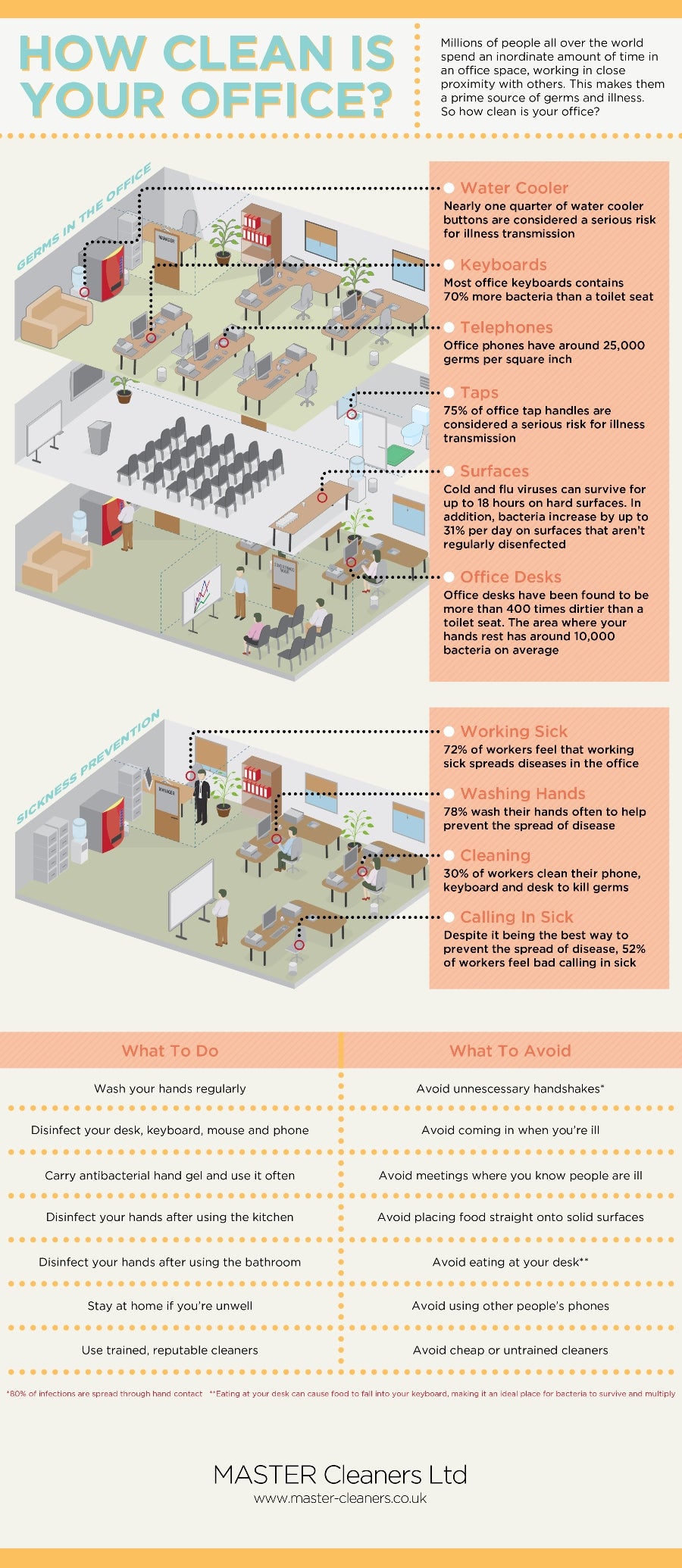
An infographic from U.K.-based MASTER Cleaners Ltd highlights the dirty secrets your seemingly-clean office is hiding.

Warning: Don't read this if you haven't eaten lunch yet.

You might think your desk is pretty clean, but take a look at what's lurking:
• Keyboards contain 70 percent more bacteria than a toilet seat.

• Office phones host around 25,000 germs per square inch.

• Office desks are more than 400 times dirtier than a toilet seat.

• The area on your desk where your hands rest has around 10,000 bacteria.
Grossed out yet? The good news is there are easy ways to fight back against the germs:
• Avoid using other people's phones.

• Don't eat at your desk.

• Stay home if you're not feeling well.

• Wash your hands regularly.
Are you brave enough to take a look at the rest of the germy secrets your office is hiding?
Click to Enlarge (+)
 
 
This article originally appeared on - PR Daily, thank you for sharing this fine article with us.
Re-posted from :http://www.entrepreneur.com/blog/224975#


Wednesday, November 21, 2012

Does going to work sick really pay?


 Working sick doesn't pay

Article by: JEFF STRICKLER , Star Tribune

More workers feel pressured to come into the office when they should stay home, but doctors and co-workers say the sacrifice is ill-conceived.

It's enough to make you sick -- co-workers who cough, sneeze and hack their way through the day while you try to fend off the swarm of germs.
With the arrival of the cold and flu season, the concern over people coming to work when they're contagious has become so prevalent that workplace experts have assigned the circumstance its own jargon: "presenteeism." As opposed to absenteeism, it refers to people who are present when they probably shouldn't be.
In addition to potentially making healthy people sick, it also can make them angry.
"I don't know if it is because of worries about job security or if it's just plain bad manners," said Clay Smith of Shakopee. "I'm dealing with it" right now, he said of working amid sick co-workers.

People who work while sick often think they deserve thanks rather than scorn, said Pat Staaden, chief operating officer of Trusight, a consulting firm in Plymouth.
"They're often doing it out of a sense of loyalty to their employer and to their fellow workers," Staaden said.
Others feel pressured by management to come in to the office, said Fran Sepler, president of Sepler & Associates, a Twin Cities human-resources consulting firm.
"Even if a company has a policy urging sick workers to stay home, these individual managers let it be known implicitly that employees who stay home are not considered dedicated," Sepler said.
Sick workers typically perform below their normal standards. The number of mistakes jumps and in physical jobs the likelihood of injury increases. And with it, the cost of workers' compensation claims. "Employees working at diminished capacity" cost businesses as much as $250 billion a year, according to the Bureau of Labor Statistics.
So how sick is too sick -- to go into the office?
"Unfortunately, there are no hard and fast rules," said Claudia Miller, an epidemiologist for the Minnesota Department of Health. "Keep in mind that some illnesses are infectious before symptoms appear."
Wearing a mask does very little good, said Dr. Melody Mendiola of the Hennepin County Medical Center's clinic in Brooklyn Center. The biggest danger comes from contact between your hands and surfaces that have been touched by the hands of a sick person. The best solution is a simple one.
"Practice good hand hygiene," she said. "That's the No. 1 thing."
People touch their mouth, nose and eyes much more than they realize, Miller said. It's a tough habit to break. According to a study at the University of California, Berkeley, which analyzed video footage of students milling around campus, we touch our faces an average of 16 times an hour.
Blaming the recession
The person credited with coining the term presenteeism is Cary Cooper, chairman of the United Kingdom's Academy of Social Sciences. He lays much of the blame on the recession and the resulting cutbacks to the workforce, which he says have instilled the fear that workers who stay home run the risk of being perceived as being dispensable.
Some people also point to the human relations policy called Personal Time Off or Paid Time Off (abbreviated as PTO) in which traditional sick days are replaced by a pool of general time off that includes sick time, vacations and holidays. The theory behind PTO is that workers who are using sick days as bonus days off will stop doing that if they have a personal investment in the time.
PTO has worked, said Karin Kurt, past president of the Minnesota chapter of the International Public Management Association for Human Resources. In fact, it has worked too well: People have started to consider every day they stay home as a day of forfeited free time.
"They see it as a trade-off between a sick day and day of vacation, and they're more inclined to focus on vacation," she said.
But just restoring the sick-day system isn't going to solve the problem, said Kurt, who works for the city of Edina. According to World at Work, a nonprofit organization that monitors human relations issues, the majority of full-time U.S. workers -- 54 percent -- still operate under a traditional sick-day policy.
Sick kid equals sick day
So why aren't people using their sick days when they get sick? Some people feel pressure to work because they've used up their available time off -- often tending to their sick children.
"I've run out of leeway," said Marilyn Johnson of Minneapolis, who feels she "already has spent more time than I should have" staying home from work when her children are too sick to go to school.
Other people can't stand the idea of work piling up in their absence. In addition, experts say that people with limited options for employment are much more likely to punch in even while sick.
And there are those who simply refuse to believe that they're sick. They are identifiable by their mantra -- "Don't worry, I'm not contagious" -- which is often punctuated by coughing.
The prognosis for the immediate future is not encouraging. With no predictions of a dramatic resurgence in the economy, most experts expect that the pressure on workers to fight for their jobs is going to grow, and with it will come heightened stress about missing work.
"It's happening in every workplace now," Kurt said. "It doesn't matter if you're in government or private enterprise, there's a lot of pressure to do more with less."


 Thank you to the  Star Tribune and Jeff Strickler for sharing this awesome read with us all! Find original source here :
 http://www.startribune.com/lifestyle/180005311.html?refer=y